
Where Are the Monks? A Medieval Faire Reflection
What would it look like if Christianity were represented at these events?
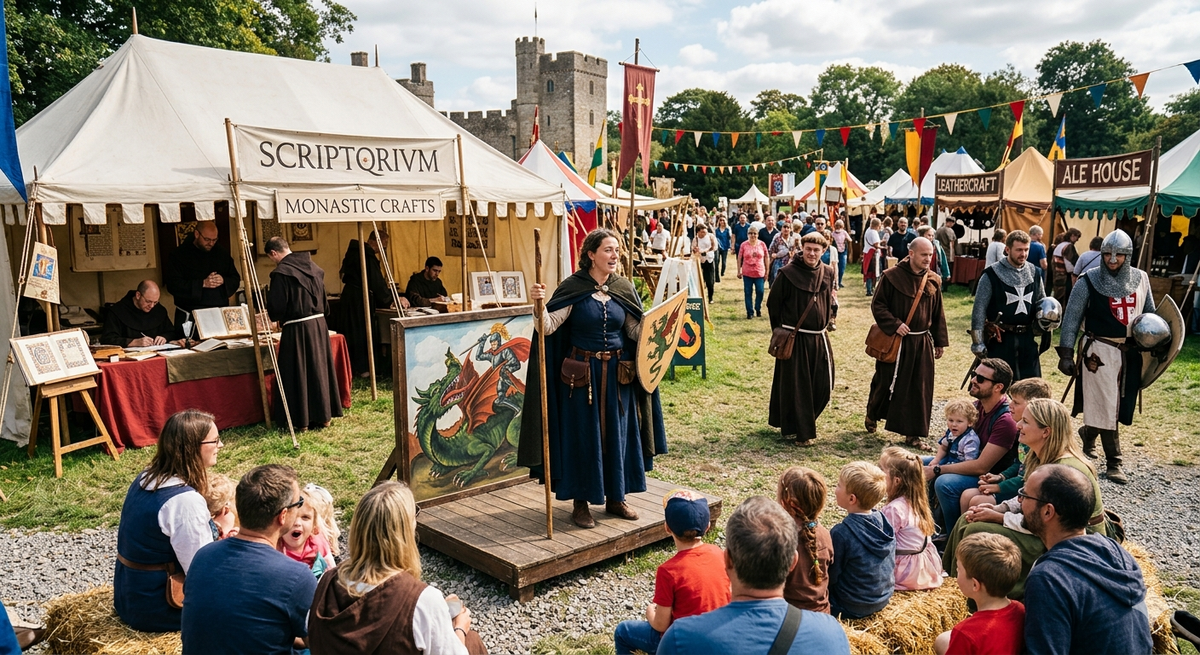
We went to the Guthrie Renaissance Fair this weekend — one of our favorite family traditions. Fair season always feels like the perfect cocktail of Oklahoma spring: lovely weather, funnel cakes, handmade crafts, and an astonishing amount of weaponry. Truly, what more could a person want.
But as we wandered through the booths and the jousting fields, something struck me. Perhaps it’s because I recently wrote about St. Patrick and what it actually means that he “ran the snakes out of Ireland,” but suddenly a major, critical group from the medieval world was nowhere to be found.
Not even hinted at.
Not even accidentally represented.
Where was the Church?
I don’t mean in a preachy, modern sense. I mean historically.
Medieval fairs are full of Vikings, pirates, druids, witches, fairies, and warriors of every stripe — but the people who actually shaped the era? The monks, the missionaries, the scholars, the cathedral builders, the artists, the theologians?
Nowhere.
And once I noticed it, the absence felt… loud.
Because the truth is, the medieval period wasn’t a pre‑Christian playground. It was a profoundly Christian era — the age of monasteries, universities, hospitals, illuminated manuscripts, and missionary journeys that reshaped entire cultures. The advancement of Western civilization and the work of the Church are so intertwined you can’t pull the threads apart without unraveling the whole tapestry.
It wasn’t the Dark Ages.
It was the candlelit ages — and the Church was the one holding the candle.
Art and architecture?
The Church was the patron.
Science and mathematics?
Monasteries preserved and advanced them.
Education?
Universities were born from cathedral schools.
Medicine?
Hospitals were founded by religious orders.
And yet at ye olde faire, the longing seems to bend toward a pre‑Christian world — a kind of wistful pagan nostalgia that never actually existed in the way it’s imagined. It’s mostly harmless fun, of course. But it also reveals a gap in the story we’re telling.
And I found myself wondering:
What would it look like if Christianity were represented at these events?
Imagine it:
- Monks wandering the grounds in their robes
- A scriptorium booth where kids try quill writing
- Story hours with saints and missionaries
- A first‑aid tent staffed by “medieval nuns”
- Chant drifting through the air
- A Knight of Christ display alongside the jousters
- Artists and musicians inspired by the sacred
It would be enchanting!
It would be historically accurate!
And it would remind people that the medieval world was not built on magic and mischief — it was built on prayer, scholarship, hospitality, and courage.
I’m still turning this idea over in my imagination (and in prayer), and I’m hoping to find some creative souls who might want to help bring it to life for next year’s festivities. Because if we’re going to have dragons — and we absolutely should — then why not tell the story of St. George while we’re at it? The lore matters.
We did have a lovely time at the Guthrie Medieval Fair this year. My twins especially adored the Dragon Run. My son, ever the brave warrior, took down many a fearsome foe. My daughter, in perfect contrast, hugged and kissed those same dragon foes back to life. A balanced ecosystem.
And maybe that’s the point.
If the faire can hold warriors and healers, dragons and dragon‑huggers, Vikings and fairies — surely it can make room for monks and missionaries too.
After all, they were there the first time around.