
The Reckoning of Time and the Resurrection
The Resurrection would be proclaimed on the same morning, in the same season, under the same rising sun.
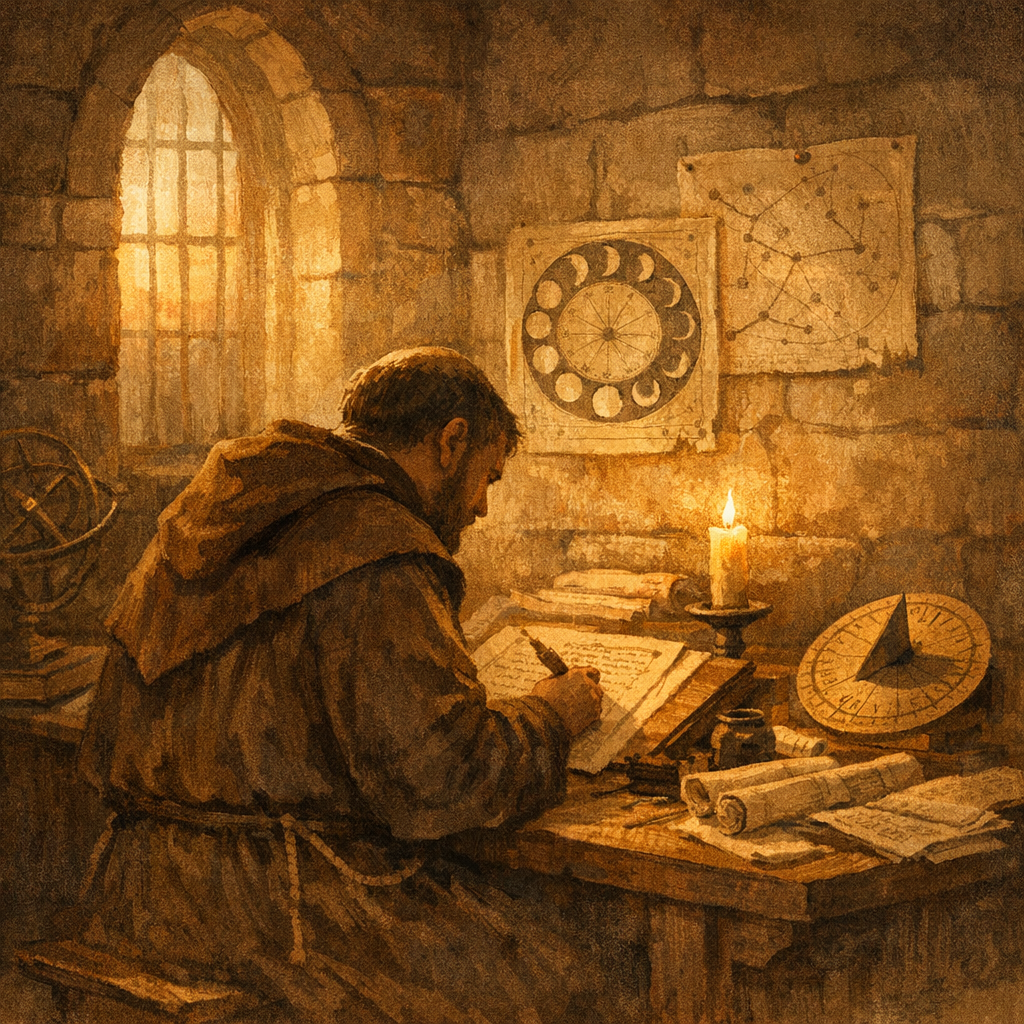
In the cold, salt‑sprayed stone walls of the Jarrow monastery in 8th‑century Northumbria, a monk named Bede (sounds like bead) spent his entire life looking at the world through two lenses: the Word of God and the movement of the stars. He rarely traveled more than a few miles from his monastery cell, yet his mind mapped the entire history of time.
Before Bede, the medieval world lived inside a chaotic patchwork of calendars. Different regions, and sometimes even neighboring churches, struggled to agree on the most important date of the year: Easter. Because Easter is a “moveable feast,” anchored to both the solar cycle (the spring equinox) and the lunar cycle (the full moon), calculating it was a mathematical nightmare. A priest in one village might celebrate the Resurrection weeks before the priest in the next valley.
Bede didn’t just want to find a date. He was seeking harmony.
If God created the universe, he reasoned, then the rhythm of the seasons and the rhythm of Scripture should not contradict each other. Time itself should be a witness to the Resurrection.
So he set out to find the Resurrection in the stars.
His greatest contribution was a work called On the Reckoning of Time, where he refined the computus — the science of calculating church feasts. It was meticulous, astronomical, theological work. And it changed everything.
The AD Breakthrough
To make his histories and calendars make sense, Bede popularized the use of Anno Domini — “in the year of our Lord.” Whether we get it right immediately or spend the first three months of the year writing last year’s date, we are using the system Bede helped cement into history. (To paraphrase Louis CK- You know how I know we live in a Christian world? What year is it?)
He also created precise tables that allowed even a simple village priest to look at the moon and know exactly when Easter should be celebrated. Suddenly, the entire Christian world could stay in sync. The Resurrection would be proclaimed on the same morning, in the same season, under the same rising sun.
The Scientific Legacy of a Monk with a Quill
What Bede likely never imagined is that his work on computus would become one of the quiet foundations of Western science.
To calculate Easter, you must understand the solar year, the lunar month, the equinox, the phases of the moon, and the drift of calendars over centuries. You must observe, measure, compare, correct. You must treat time as something that can be studied.
In other words, computus required the church to take astronomy seriously.
Bede’s tables trained generations of monks to track celestial cycles with precision. His insistence on harmonizing Scripture with creation helped preserve astronomical observation through the early medieval period — a fragile era when much scientific knowledge could have been lost. The very act of calculating Easter became a school of mathematics, astronomy, and record‑keeping.
Long before universities existed, Bede helped create a culture where studying the heavens was an act of worship.
And that scientific posture — that the world is ordered, intelligible, and worth measuring — became one of the seeds from which Western science eventually grew.
A Quiet Legacy That Still Shapes Us
From the tiny shores of England, Bede’s work traveled across Europe. He became known as the “Teacher of the Middle Ages.” By standardizing how we measure years and how we find Easter, he ensured that the central story of his faith wouldn’t be lost in a sea of confusing dates.
He turned time itself into a tool for worship.
And because of him, Christians across the globe — and across the centuries — rise on the same morning to proclaim the same truth: He is risen. The sun may climb over different horizons, but the church greets it in unison because a monk in a stone cell believed that the Resurrection deserved a shared rhythm.
His quiet faithfulness still gathers us. It still steadies us. It still teaches us to mark our days by the light of Christ.
Every Easter, when the church lifts its voice as one people in one great chorus of praise, we are living inside the harmony Bede sought — a harmony that has outlasted kingdoms, languages, and empires. A harmony that will continue long after us.
And I am grateful for him — for the man who stitched the calendar to the Resurrection so the whole world could celebrate together, year after year, age after age.