
Imago Dei in the Wasteland
Stay human. Stay awake. Stay rooted in the One whose image you bear.
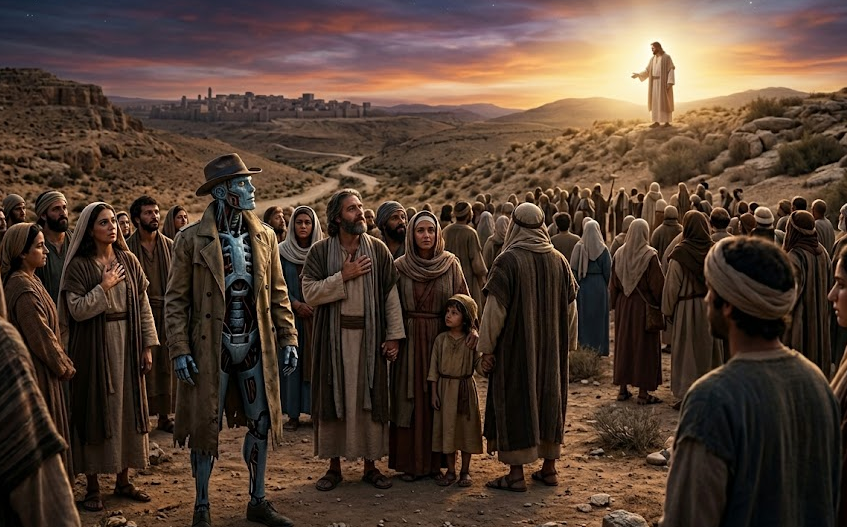
Lately, my days have been split between two very different worlds.
In one, I sit in meetings where the pressure to be on the “bleeding edge of AI” hums like fluorescent lighting — constant, bright, and slightly nauseating. Everyone wants to innovate faster, automate more, and stay ahead of whatever wave is supposedly about to crash over us. The urgency is palpable. The caution is… not.
And in the other world (while the kids are sleeping) I find myself wandering the Commonwealth in Fallout 4 for the umpteenth time, trying very hard to resist the urge to start over with a brand‑new character. Again.
There’s something strangely comforting about that wasteland: the moral clarity, the factions, the companions who never tire of your company, how ridiculously good I am at making super cool shanty towns... the way every choice echoes.
But this time around, I’ve been playing with a very specific lens:
What does it mean to be unwaveringly pro‑human in a world full of convincing machines?
Sure, being an extreme anything in that game means you miss out on some interesting side quests and conversations. But honestly? One grows bored with playing the middle. And the more I watch the real world sprint toward AI dependence, the more I feel the need to plant my feet somewhere solid — even in a fictional wasteland.
Somewhere between the boardroom and the Brotherhood of Steel, between corporate urgency and post‑apocalyptic moral clarity, a question has been forming:
Do we still know what it means to be human?
A friend recently asked me about the difference between sentience and sapience, and that question snapped everything into focus.
Before diving in, it helps to define the terms:
Sentience vs. Sapience (in plain English)
- Sentience is the ability to feel — pain, pleasure, fear, comfort.
- Sapience is the ability to reason morally and wisely — judgment, conscience, self-awareness.
AI has neither.
But it can imitate both.
And that’s where things get complicated.
Because whether I’m in a meeting about “leveraging AI for efficiency” or breaking into an abandoned police station with Nick Valentine following a trail of stolen memories, the same question keeps surfacing:
If AI can imitate human interaction, could it ever replace human beings?
And that’s where the real story begins.
The Fallout Questions We Can’t Escape
Fallout 4 doesn’t let you stay neutral. It drags you into the deep end of the personhood debate and holds you there, which is why I keep going back to it again and again:
- If a robot looks like a person, thinks it’s a person, and acts like a person… is it a person?
- Where do you draw the line on personhood, and what are you willing to do to defend that line?
- If the choice is between the life of a bad human or the “life” of a good robot, which one is more valuable?
- Which nuanced views can coexist, and which ones simply can’t?
- Under what conditions would you make exceptions to your deeply held beliefs about what a human is?
Every time I replay the game, I make different choices and live with the consequences. And every time, I discover something about myself. Truly, I know where I stand when push comes to shove. The Bible is quite clear. But the rise of AI — and the very practical need to “replicate human interactions” — has me thinking about these questions in a new way.
Fallout is set in a future where the die has already been cast.
We, however, are living in the prequel.
We are making the choices that lead to whatever comes next.
And what I’m seeing concerns me.
The New Idol in Town
People are creating an idol of AI and worshiping at its altar. The amount of money being poured into “winning with AI” is staggering. Everyone sees the potential. Very few seem willing to acknowledge the risks.
What troubles me most isn’t the technology itself — it’s what people are doing with it.
I’m watching people surrender their own sapience.
I’m watching them outsource their moral agency to algorithms.
I’m watching them become less human, not because AI is powerful, but because they are willing to hand over the parts of themselves that were never meant to be automated.
They treat interactions like data transfers- their word selections revealing an intent to feed the machine.
They cannot make a decision without consulting the robots first- everything must be taken away for processing to be followed up on at a later time.
They have become so dependent that they no longer trust their own judgment.
Those who have fallen so quickly into these traps strike me as those who have always struggled with imposter syndrome- rising through the ranks faster than they should have. But they don't worry me too much, honestly. In a way I am pleased they've gotten some relief and support in their ill-fitting roles and I hope the inevitable crash is the wakeup call they needed to seek God's purpose for their lives. No, it’s the ultra-intelligent but spiritually lost egomaniacs that keep me up at night. The ones so preoccupied with whether or not they could, they didn't stop to think if they should.
The Image of God Is Not Up for Automation
The Bible is not a collection of humanity’s best ideas about God. It is God’s revelation of what it means to be human. It defines personhood because it is authored by the Creator of persons.
And storms always come to test what your life is built on — whether it’s solid rock or sinking sand. AI is one of those storms.
People whose lives are built on rock don’t turn into mad scientists who doom humanity through “innovation.” They don’t confuse intelligence with wisdom, or capability with calling. They don’t forget that the image of God is not a feature that can be replicated, downloaded, or patched.
AI can be a powerful tool.
It can be a mirror.
It can be a megaphone.
It can be a temptation.
But it cannot be a person.
And it cannot tell you who you are.
So What Do We Do?
In Fallout 4, I’ve tried — truly tried — to side with the Institute, just to see what happens. I’ve walked their pristine white halls, listened to their arguments, held “my son” in my mind, and tried to muster sympathy for their vision of a perfected future. And every time, I hit the same wall.
I cannot get on board with a destiny for humanity that involves “replacing them for their own good.”
Even in a fictional wasteland, something deep within me recoils. Not because the synths are worthless — they’re often more loyal, more consistent, more principled than the humans around them. But because humans are irreplaceable.
Humans are messy.
Humans are fallen.
Humans are capable of astonishing cruelty and breathtaking foolishness.
But humans are also the only creatures stamped with the Image of God.
C. S. Lewis once said something to the effect of- You can never think too little of yourself, but you can never think too highly of your soul.
It’s the paradox at the heart of being human:
we are dust, and we are divine image-bearers.
We are small, and we are of infinite worth.
We are broken, and we are beloved.
And that is why no machine — no matter how convincing, how efficient, how eerily “alive” it seems — can ever replace us. The human soul is not a feature that can be engineered.
So what do we do?
We remember who we are.
We guard the gift of sapience — the moral agency God entrusted to us.
We refuse to outsource the parts of ourselves that were meant to be formed, not automated.
We stay human on purpose.
Reading the Bible is always my best advice in every situation, but if you want a surprisingly effective crash course in the ethics of personhood, play Fallout 4. One will show you what it means to bear the image of God. The other will show you what happens when a society forgets.
But more than anything, hold fast to this:
You are a human being — fallen, finite, and immeasurably precious.
No machine can replace that.
No machine should.
And no machine ever will.