Abigail, and the Woman My Husband Sees
This certainly isn't the kind of thing my husband would say to me directly
A number of weeks ago in our Sunday School class, a couple tossed out a simple question that turned out not to be simple at all:
Which Bible character is most like your spouse?
We all sat with it for a moment. My husband has traits I admire that echo many people in Scripture. The redemptive nature of our marriage makes Boaz an obvious choice. His love of poetry makes him a little like David. He argues like Paul. He grumbles about the state of the world like Jeremiah. He’s hairy and likes stew…like Esau.
Alright, alright.
In the end, I chose John — the apostle whose gospel arrives last, not as a repeat of the story but as a revelation of its depths. John ties threads together. He listens, then responds with meaning. He gets to the heart of things. That is my husband.
Then it was his turn.
He said I’m like Abigail. “She makes things okay when I mess up,” was all the explanation he offered.
You could’ve given me a hundred guesses and I would not have landed there. Abigail? I’ve never seen myself in her story, and my husband is certainly no Nabal. Was this just some self-deprecating nonsense he was dragging me into? I thought I honored him pretty well with my selection, especially when providing the justification. Was he responding with a joke? I couldn't tell. I smiled, nodded, and resisted the urge to interrogate his reasoning, because Abigail was already on my list of biblical characters to spend time with this year. I’d revisit it when the lesson arrived in my plan... and here she is.
Meeting Abigail Again
1 Samuel 25
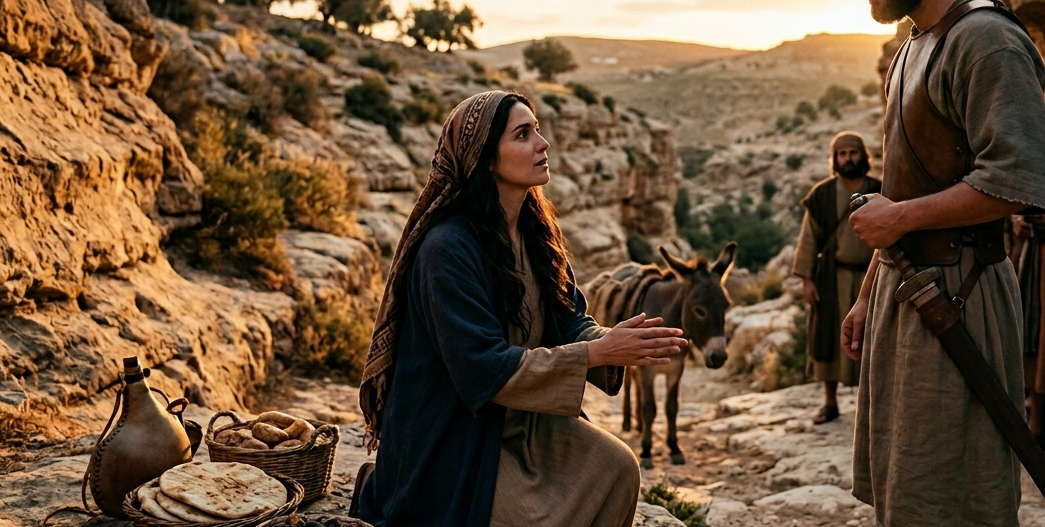
David comes seeking hospitality. Nabal responds with dishonor. David prepares for bloodshed. And Abigail — swift, wise, steady — steps into the breach. She brings provisions, takes responsibility, and speaks words that soften David’s rage. She returns home, tells her husband what she has done, and he collapses. Days later, he dies. David hears the news and asks her to become his wife.
At first glance, her speech to David can sound like the familiar language of a woman surviving a brutal marriage — placating, redirecting, absorbing blame to preserve peace. Her servants clearly trust her more than their master and when they ask her to intervene there is an obvious understanding between them. Nabal is a man who is feared, maybe, but not respected. She has done this beg-for-mercy thing before.
But when I slowed down, something else emerged.
Her words read like prophecy.
She doesn’t merely flatter David or repeat political rumors. She speaks of a lasting house — a covenant God will later articulate through Nathan in 2 Samuel 7. She reframes David’s wilderness years not as running for his life but as “fighting the battles of the Lord.” She is not manipulating him to save her household. She is intercepting him. She is a divine course‑corrector, standing in the gap at a hinge moment in Israel’s history. The holy words do their holy work and David stays on the straight and narrow.
And then she goes home to her brutish husband.
A Woman Forged in Fire
I’ve never paid attention to this before, but Abigail is one of Scripture’s clearest portraits of a woman in a toxic marriage. And yet she is not passive. She does not quietly endure destruction. She takes radical, independent action to protect life. She stands against her husband’s folly and she shields her household from his fallout.
God does not restore her marriage. God does not change Nabal’s heart. God removes him — and moves her.
But only after she fulfills her purpose.
Her years in that household were not wasted, and while she may have felt like a prisoner at times, the situation was preparing her. That toxic marriage was the fire that forged her discernment, her courage, her emotional intelligence, her ability to read a room and act decisively. Everything she learned in that crucible prepared her for the moment she would save David from bloodguilt and alter the trajectory of a kingdom.
Where Her Story Touches Mine
I have never been in a marriage like Abigail’s. But I did grow up in a home marked by significant mental illness. I, too, developed emotional intelligence out of necessity. I learned to read the air, to navigate instability, to discern motives, to act quickly and quietly. As a young person, that “wisdom” was sharp and guarded — a shield.
As God has healed those places, that wisdom has softened. It has become a mantle of peace to bless others rather than a mechanism of survival. Glory be to God.
Looking at Abigail again, I see a woman whose spiritual maturity is not theoretical. It is lived. Tested. Tempered. And while my first association was that she covers up for Nabal being the worst, I see it more clearly now:
She guards the character of both of her husbands — but not in the same way.
With Nabal, she guards his reputation out of survival. She absorbs the fallout of his folly because lives are at stake. She steps between him and disaster because someone must. Her wisdom is protective, necessary, forged in fire.
With David, she guards his character with divine power. She doesn’t shield him from consequences; she shields him from becoming the kind of man who would shed innocent blood. She speaks truth that redirects a king. She preserves his integrity, not his image. Her wisdom becomes prophetic, expansive, anchored in God’s purposes.
One husband she protects from himself.
The other she protects for the sake of who God is making him to be.
And suddenly, I understand why my husband chose her… and truth be told, I can hardly bear it.
He sees me.
He sees the depths.
He ties the strings together.
He did his John thing on me and named truth beneath the surface.
He is not Nabal. He is David — a man after God’s heart. I probably should have seen it right away. My husband is literally a man who has carefully guarded his life since he was a teenager to ensure if he were ever called into ministry, a foolish error wouldn't disqualify him according to Timothy standards. He's a faithful man and a faithful head of our household. But as we get older and the pressures of life build, he has become a man who sometimes needs a steady voice to cut through the passion of a moment, calm the storm, and remind him who he is and where God is leading.
Abigail.
That is what I am to him, and for him.
I never put words to the kind of wife I have become — the wife God has shaped me into. And this certainly isn't the kind of thing my husband would say to me directly, hence my earlier confusion. But now I know.
I know because my husband got to the heart of me.
He honored me.