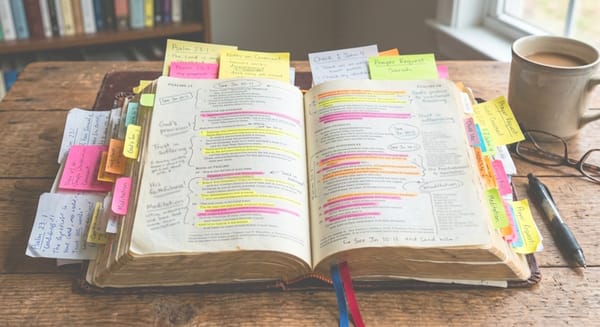
You Are My All In All
The hymn that began as a private prayer from a man at the end of himself became a universal confession of dependence, longing, and hope.
By the late 1980s, Dennis Jernigan was a man living two lives. To his church community in Oklahoma, he was a gifted worship leader—talented, faithful, dependable. But internally, he was unraveling. For decades he had carried a secret he believed made him fundamentally broken in the eyes of the God he longed to serve: unwanted same‑sex attraction.
He had spent years trying to outrun it through performance-based faith—more worship, more devotion, more striving. If he could just be good enough, holy enough, disciplined enough, maybe the feelings would disappear. Instead, the fear of being exposed only grew heavier. By the time he sat down at his piano one afternoon, he wasn’t simply tired- he was spiritually and emotionally bankrupt. The secret he carried had become radioactive, burning through every layer of his life.
The Piano as a Confessional
That day, Jernigan didn’t approach the piano as a worship leader preparing a song. He approached it as a drowning man gasping for air. Music had always been his first language with God, and he needed to speak plainly.
He began to play a simple, repetitive melody—less a composition and more a heartbeat. As his fingers moved, he found himself reflecting on the nature of God’s sufficiency. He had tried for years to change himself through sheer willpower and failed. But what if the point wasn’t his strength at all?
What if having everything in the world meant nothing without a connection to the divine? And what if having nothing—no reputation, no control, no perfection—meant everything if he still had God?
In that quiet moment, something shifted. He began to realize that his worth did not hinge on his ability to be flawless. It came from being received in his current, fractured state. Out of that realization came the line that would circle the globe: “You are my strength when I am weak.”
Redefining “All in All”
The phrase “All in All” became more than a lyric. It became a declaration of identity.
His reputation, his ministry, or even the illusion of self‑control, he was finally willing to lose it all if it meant being defined by the One who lovingly created him.
He moved through the metaphors of a “precious jewel” and the “Lamb of God,” not as poetic filler but as anchors. His identity was no longer tethered to his own strength or preferences. It was rooted in being lifted, held, and named by Someone greater. He recognized that he was not enough, but Jesus is. And in that truth, he found rest.
A Legacy of Vulnerability
In time, Jernigan chose to go public with his story. He became a prominent voice in the ex‑gay movement, and “You Are My All in All” became the anthem of that transition. But the song’s enduring power reaches far beyond the specifics of his struggle.
It resonates because it gives language to anyone who has ever felt their identity was a source of shame. Anyone who has ever whispered, “I want to be made new.”
The hymn that began as a private prayer from a man at the end of himself became a universal confession of dependence, longing, and hope. It is a reminder that wholeness is not found in our ability to fix ourselves, but in the One who calls us worthy even in our weakness. While we were still sinners, Jesus died for us.
And this is where Jernigan’s story brushes against mine. We are brother and sister in Christ, bound not by shared circumstances but by the same cry of the heart—the longing to be restored, renamed, and made whole by Jesus. His confession at the piano echoes my own in a different key, and now we sing it together.