
The Valley of Decision
When vessels break, the battle is won.
Judges 6-8 seems like a lot of text for Gideon. Perhaps it is a lot of ink compared to how quickly the book of Judges moves through other figures like Shamgar, who gets a single verse, or Tola and Jair who get just a few verses each. I admit, Gideon has often puzzled me in part because of the comparative length, but also because he demonstrates such a weakness of faith. He’s not alone in his reluctant obedience but the legacy he leaves isn’t anything to be proud of. He’s no Moses. Gideon is… not impressive.
Those stubborn Israelites. Those wandering sheep. Gideon is one of the judges that God uses to move them through history, but it’s such a weird story! I once received a free New Testament from Gideon's International, which didn’t even include Gideon’s story. Why name a ministry after this particular judge? Maybe the founder was named Gideon. Maybe it had nothing to do with the biblical figure at all.
Still, I come to Gideon with an open heart. Like so many other biblical characters I’ve spent time with this year, I pray that God shows me the person He knows.
God Appears in the Dark
God meets Gideon in the deep dark. At twilight in the thickest darkness of a winepress, secretly threshing wheat. A paralyzed soul in the womb of chaos. He is from the weakest clan and the least in his fathers house, yet the Angel of the Lord appears and addresses him as a valiant warrior. There is a battle coming against the Midianite oppressors, and Gideon, a coward and a nobody, is meant to lead the people.
God has given Gideon a miraculous sign: fire consuming meat and unleavened bread from the rock. He has given explicit verbal promises and destroyed the Baal altar. And yet Gideon demands more proof. No less than reversing the order of nature… twice. Gideon puts God on trial, demanding signs after God has already given one. Ugh, Gideon! That seems like a major no-no. Why this guy, God? Why enter into a covenant with a man who is actively negotiating with You like this? There must be someone better suited for this, right?
Gideon is no Moses, but like Moses, he is the archetype of the reluctant vessel — human weakness suddenly confronted by grace. He is the template of fear meeting divine patience. He is all of us. He is a warning for us.
Even though I like to imagine myself more faithful, it is suddenly comforting to see how patient God is with Gideon, and how much reassurance Gideon needs. I understand that.
The Emptying of Gideon
Gideon the valiant warrior is called to lead an army into battle. God wasn’t looking for self-sufficient power, but emptiness. When God calls upon such a loser, like Gideon, it seems to mean that He intends to do remarkable, unmistakably God things. And lo, and behold, Gideon’s campaign is to be in the Jezreel Valley/Harod Valley. The shadow of Armageddon.
Yet another miracle occurs when the people decide to rally behind Gideon and join him in his cause. Lots of people, actually. So many people join that one might argue they simply overpowered the Midianites. In Judges 7, God dismantles this military framework from 32,000 down to 300.
First, they tell the frightened, the spiritual cowards to go home. Those men had a reason for being there, but it wasn’t the right reason. And the remainder are separated by whether they drop to their knees and stick their faces in the water to drink or scoop up water and drink out of their hands. I don’t know if there is any significance to which method God seems to prefer in this situation, but I do find it a bit amusing that 9,700 of the remaining men all dunk their faces into a river to drink. I can't say that I've ever seen a person do that, but it's not a great look. God ended up with 300 men who have at least a shred of dignity.
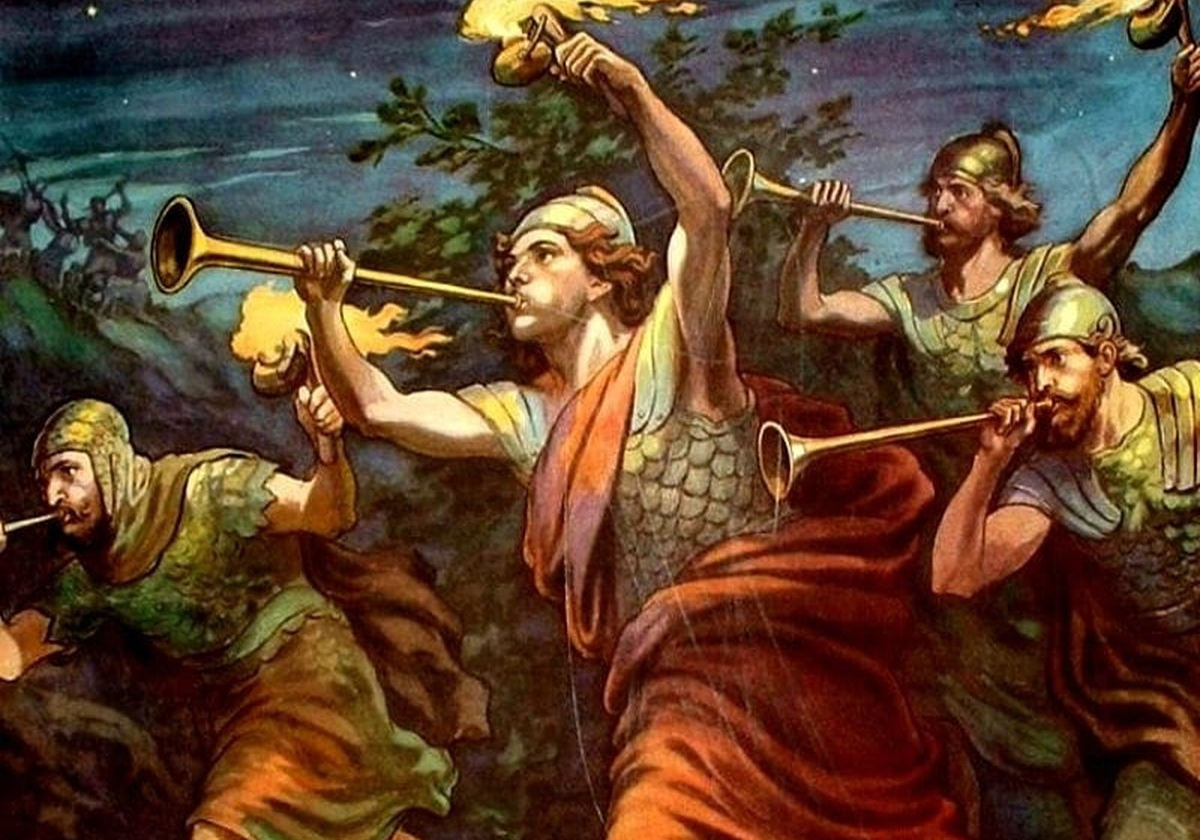
But does it really matter the reason why those 300 were chosen over the others? They never land a blow. All they do is break some clay pitchers and blow trumpets!
The Valley of Decision
In the valley of Megiddo and the Harod springs - the valley of decision - a conflict unfolds that has been fought many times and will be fought until the final day. The symbolism is overwhelming once you see it. The valley is flat, open, exposed: the arena of human history where the powers of this world swarm like locusts, stripping the land bare.
Midian represents the relentless, parasitic weight of sin and oppression that consumes human potential, leaving the soul impoverished and hiding in caves and winepresses.
By replacing swords with trumpets, clay pitchers, and burning torches, God demonstrates that His victories are not achieved by human might but by the breaking of earthen vessels so His light can shine forth. It is a literal enactment of the truth that the battle belongs to the Lord.
If we pull Gideon’s narrative out of strict historical reading and consider it allegorically, every detail from the location, the man, the props, and even the failure map onto the human condition and God’s method of spiritual rescue.
And look at how Midian loses. They are not overpowered. They self-destruct.
“The Lord set every man’s sword against his companion throughout all the camp.”
This is the ultimate picture of spiritual warfare. The victory doesn’t come from crushing the enemy with outside force; it comes from the breaking of the vessel. As long as the clay pitcher is intact, the light is hidden. Only when the shell is shattered does the blinding, terrifying light of God burst forth into the dark camp of the enemy, throwing them into absolute panic.
This internal collapse, where God's enemies turn on and consume one another, is a recurring motif for how ultimate rebellion against God collapses under its own weight. We see this exact pattern in the prophetic pictures of the final day, where the nations gathered against Jerusalem fall into confusion and self-destruction. The Rider on the White Horse does not win through conventional military buildup, tactical maneuvering, or human weaponry; He wins by the sword coming out of His mouth- the sheer spoken power of God.
Sin and darkness are fundamentally self-destructive. When divine light breaks through a broken vessel, the forces of evil implode under the weight of their own confusion. The battle is won not by the direct execution of wrath by the hands of the saints, but by the adversary collapsing inwardly.
Gideon’s entire journey from fear to faith is the symbolic trajectory of a human soul being stripped of its own resources so it can house divine power. His battle is like a rehearsal of the ultimate spiritual reality: human armies stripped bare, divine light breaking through broken vessels, and God stepping in to shatter the forces of oppression entirely apart from human boasting.
The Failure After Victory
The Gideon story refuses to let us view human deliverers as ultimate saviors. Right after achieving a miraculous victory where God was explicitly king, Gideon creates an ephod out of the gold plunder, which Israel ultimately turns into an idol that leads them whoring after other gods. I know I said he’s no Moses, but doesn’t this sound exactly like Aaron melting down the gold jewelry of the Egyptians and making a golden calf and leading them to spiritual adultery?
This is the sobering symbolic warning that even the instruments of deliverance easily become idols. Humans love to institutionalize, memorialize, or worship the instrument (the leader, method, movement) rather than the invisible God who performed the rescue. Even a deliverer like Gideon leaves a legacy of spiritual stumbling, proving that no human savior can anchor the soul permanently.
It highlights a recurring theme of the Bible- even the greatest human heroes fail, and corruption quickly follows a crisis if true spiritual fidelity isn't maintained. It points forward to the absolute necessity of a sinless King, contrasting every flawed human judge with the final, unblemished victory of Christ in Revelation.
The Legacy
I don’t know if this study has changed my mind about Gideon as a man. He is born, raised, and funded out of a household that coexists with idolatry. Even though God uses him, Gideon never truly breaks free. He doesn’t really become a new man, he just abuses the gift that God has given him. But all that ink means Gideon acts as a massive narrative centerpiece. His story slows down to thoroughly expose both the radical grace of God and the stubborn frailty of human leadership.
And I suppose he has a legacy of another sort. Gideon’s International didn’t adopt the judge’s character; they adopted his moment. Their name points back to the night when three hundred trembling men lifted torches in the dark and watched God do what no army could. It is a nod to the book of Judges itself - a declaration that even now, God sends His people into the world with nothing but light, witness, and the confidence that the battle is His.