
The Tent Peg and the Iron Chariot
This is not a feminist triumph. It's tragedy.
In doing Bible character studies, you will inevitably encounter this thought-provoking takeaway- “God uses unexpected people!”
While true, I have started bristling at the phrase when it comes up. It’s become a cliche, and the darker and grittier the person’s actual story, the more egregious it seems to turn them into some cartoonish motivational poster. It is certainly a fact that most of the people in Scripture were nobody until God came along. And that is certainly true in my own life, as well. But how unsatisfying to look at their testimony, shrug your shoulders, and say, “I guess it’s true that God uses unexpected people!” Herpy derpy derp.
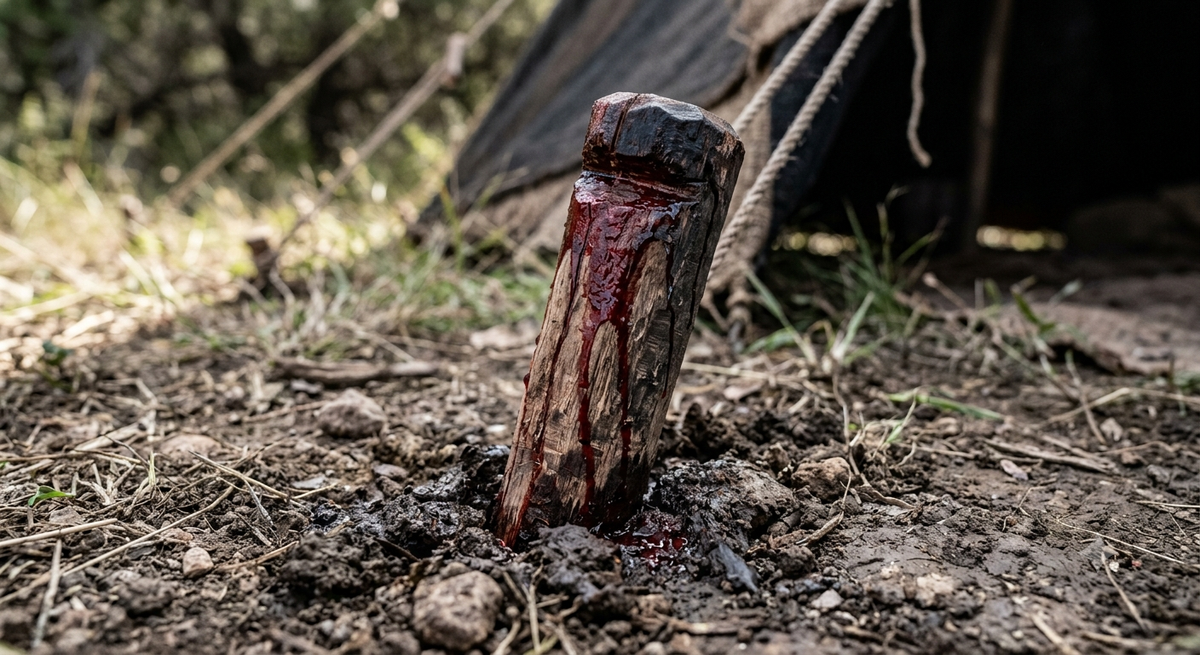
I’ve had Jael on my list for quite a while. Her story is one of those wild encounters I love sharing with a class of 8-9 year old boys who go completely nuts at my dramatic reading of Judges 4 when she drives the tent peg through Sisera’s head. Their reaction of, “Woah! I can’t believe that’s in the Bible!” echoes my own reaction the first time I read it, and it has caused the story to stick with me. Unfortunately, most of the study material I have come across that references Judges 4 flattens the story into a “surprise hero” narrative.
Let’s unpack Jael’s story a bit. It’s presented in a journalistic, just-the-facts manner which can be rather frustrating. I would love to understand her motivation. I would love to know what she was thinking. I would love to know more about her circumstances. Her actions fulfill prophesy, but there’s no record of her receiving any kind of divine direction. In Scripture, when someone fulfills prophesy, God gets the credit, even if the human behavior is perhaps shocking, and quite messy. That’s, of course, where the credit belongs, but I still want to know what’s going through her head (not just what’s going through Sisera’s head… hey-o!).
The Collapse of Order in Judges
Here’s what we do know about her circumstances. It’s in the book of Judges, so right away we know it’s a time when everyone did what was right in their own eyes, including Jael. The people were selfish, wicked, and lost and Israel was spiritually very weak. Jael was a Kenite, who separated from Israel, moved far away from their brothers, and decided to hedge their bets a little by having a neutral alliance with all sides. They reckoned the safest place was far away from all of it, on semi-friendly terms with everybody.
Israel was embarrassing and cowardly, truth be told. Barak, the designated military commander, refused to go into battle unless Deborah held his hand. God told him he would win, and yet he put more faith in Deborah’s presence than God’s decree. The tribes of Israel spent the crisis hiding out or staying safely in their own regions while Sisera terrorized them. It wasn’t safe to travel the roads. There was no unity among the people. If we think of Jael as an unexpected hero, it’s not simply because she’s a woman in a tent. She steps up because every man whose job it was to fight had failed to do so. God didn’t bypass the system just to show off or make some statement about girl power. He bypassed a vacuum of male courage entirely.
I speak often of gender roles and the importance of people and relationships being rightly ordered and existing in the proper geographic domain. For me to do woman things, a man must do man things. I’m not talking about a division of chores or something, but specifically guarding the gate. Protect my spaces and defend my borders. If it is on my shoulders to protect the flock from wolves, then it cannot also be my job to enrich the lives of the flock. Put another way, if I must be concerned with Church leadership, membership, and spiritual discipline, then I cannot also care about ladies fellowship or nursery duty or coordinating VBS. The real tragedy there isn’t so much about social activities being neglected but a woman being forced to take on a role not meant for her because men have abandoned the post. When Deborah tells Barak that the glory that should’ve been his will go to a woman, he should be ashamed that he did that to those women, not just feel sorry for himself for not getting the glory.
A Tent at the Crossroads of War
Jael’s gate was unguarded. The Kenites were survivalists playing both sides from the edges of the blast radius. They were tolerated because they were generally harmless and cooperative, but the tides could turn any moment if they weren’t careful.
Although everyone did what was right in their own eyes, the laws of hospitality in the ancient Near East were still sacred. When Jael invited Sisera into her tent, and gave him milk, that implies the protective status of a guest. She covered him and promised him safety, entering into a deeply binding social covenant. He actually fell asleep, which suggests he really trusted her, or at least he trusted that social covenant.
I can’t help but wonder what her motives were! Remember, they were playing both sides. Did she lure him in, intending to kill him? Or was she genuinely offering him protection and then saw a once-in-a-lifetime opportunity to bring the war to an end? We don’t know for sure, but executing Sisera while he slept under a specific guarantee of protection wasn’t just “unexpected,” it was a shocking, calculated betrayal of the highest social order. Jael’s fearlessness isn’t the calm cool confidence of a soldier, but the hyper-focused terrifying clarity of a desperate person backed into a corner. The text doesn’t pretend this is clean.
Violence That Should Not Be Sanitized
There is an additional dark irony in Jael’s weapon that goes deeper than some lady using stuff around the house. Sisera was the commander of a massive, technologically advanced military machine featuring 900 iron chariots! That was the ultimate weapon of mass destruction of the day and he had 900 of them. Those iron chariots paralyzed Israel with fear for 20 years. How does God dismantle this terrifying juggernaut? A wooden tent peg and a mallet. Don’t miss this cosmic punchline: the mighty iron empire of Hazor is brought down by the domestic tool of nomadic life! They understood this as the sickest of burns back in their day, so make sure you stop to appreciate it.
God can, and does, use messy, jarring, and unconventional means to rescue His people, operating completely outside the boundaries of human expectation or polite convention. The Judges era is a dark time in Israel’s history and God steps in repeatedly with bloody spectacle. Ehud assassinates King Eglon. Shamgar slaughters 600 Philistines with a cattle prod. Samson prays for one final act of strength to basically suicide bomb the Philistines and destroy the temple of Dagon.
When we say “God used Jael,” we can make it sound like a smooth, divinely scripted play. But real deliverance in the Book of Judges is bloody, traumatic, and leaves permanent scars. Jael’s act saved Israel, but it also plunged her and her clan into a terrifying geo-political reality. She lived in a tent on the edge of conflict and her actions forced her family to pick a side in a blood feud. That is not a cozy fable about self-esteem or how anyone can make a difference. It’s a raw, jarring look at how God steps into the worst, most morally ambiguous messes of human history and wrenches survival out of the jaws of absolute tyranny- using people who are forced to make horrifying choices in the dark.