The Myths We Still Need
Middle‑earth, Narnia, and the world of Quirks all whisper the same ancient truth: our strength is never enough, but grace is.
Human beings have always told stories to make sense of the world. Long before we had textbooks or theories, we had myths—tales of dragons and heroes, of impossible quests and unexpected grace. These stories were never meant to be escapism. They were meant to reveal reality. Chesterton once wrote, “Fairy tales do not tell children the dragons exist. Children already know that dragons exist. Fairy tales tell children the dragons can be killed.”
That insight has never stopped being true.
But somewhere along the way, many of us began to treat myth as something belonging to the past—something for medievalists, theologians, or children. Meanwhile, whole new mythologies were springing up in places we weren’t looking. Anime, for instance, is often dismissed by traditionalists as unserious or juvenile (or demonic and perverted, which is a completely valid generalization, however not an actual requirement of the medium). Yet the best of these stories, regardless of medium, carry the same ancient power: they name the dragons, and they show us how they fall.
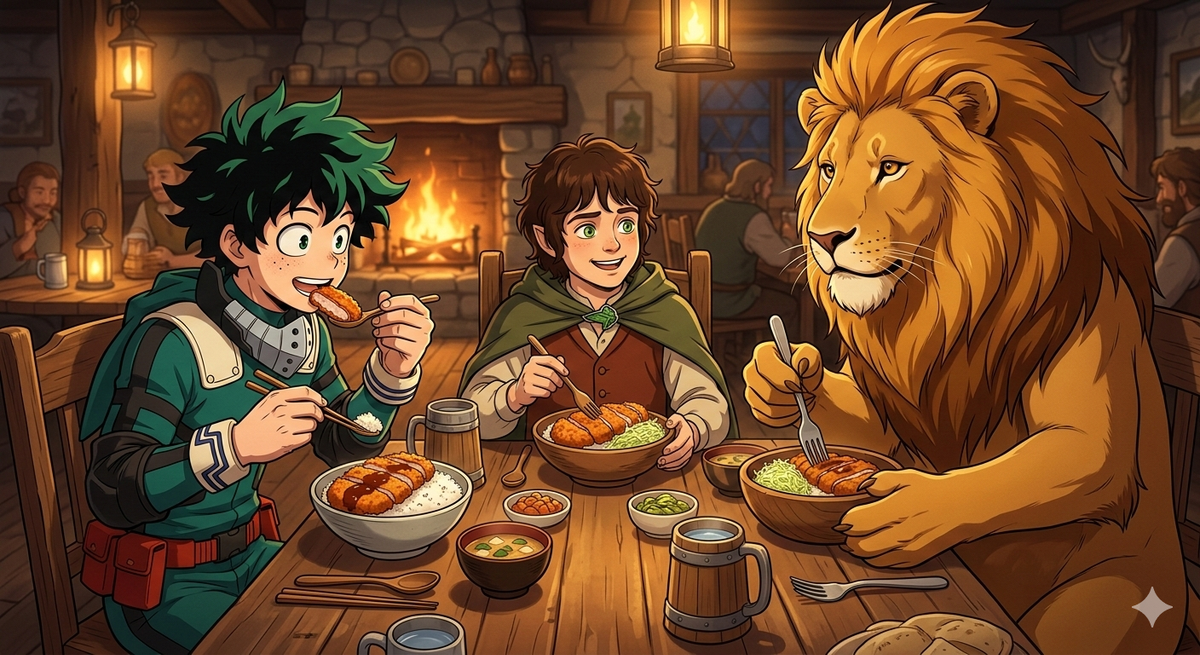
This is what surprised me when I watched My Hero Academia with my husband and kiddos. Beneath the music, bright colors, and superpowers, I found a story humming with the same deep magic found in Tolkien’s Lord of the Rings and Lewis’ Narnia series. MHA is absolutely bursting with virtue. It is by no means an explicitly Christian story, but it is a story about courage, calling, sacrifice, and the grace that meets us when our strength fails.
And that realization opened a door.
Once you begin to see the parallels, they refuse to stay quiet. These three worlds- Middle‑earth, Narnia, and the world of Quirks- are separated by centuries, cultures, and genres, yet they are built on the same ancient scaffolding. They are stories about the limits of human strength, the surprising grace that arrives when all seems lost, and the kind of love that remakes the world from the inside out.
Chosen Nobodies
Every great myth begins with an unlikely hero. Not the strongest, not the most gifted, not the one anyone would have chosen. Frodo is a hobbit- small, provincial, uninterested in power. The Pevensies are ordinary schoolchildren, swept into a world they never asked to rule. And Deku? He is quirkless in a society where power is everything. His power is gifted to him by the appropriately-named All Might due to the strength of Deku’s moral character and his total lack of physical strength.
None of them earn their calling. None of them are qualified for it. They are chosen because they are willing to love, to suffer, to hope.
This is the first note of the deep magic: grace before merit.
The Joyous Turn
Tolkien’s word for this was eucatastrophe—the sudden, joyous turn when despair gives way to deliverance. It is not a cheap trick or a deus ex machina. It is the reward of faithfulness, the fruit of mercy, the moment when grace breaks through the cracks of human limitation.
Frodo fails at the very edge of victory. His will collapses. The Ring wins. And yet the world is saved not by Frodo’s strength, but by the mercy he showed Gollum earlier in the story.
MHA mirrors this with startling clarity. Deku cannot defeat Overhaul. He is outmatched in every way. Victory comes only through Eri, whose rewind quirk is a power Deku didn’t earn and cannot control.
Grace interrupts despair. Help arrives from beyond the hero’s strength. The dragons can be killed, but not by the hero alone.
The Deeper Magic
Lewis wrote of a magic older than the world - divine order. Self‑giving love, the pattern of reality established by God before the dawn of time. This is why Aslan’s sacrifice is not merely moving; it is powerful. When the innocent dies in the place of the guilty, the Witch’s legal claim collapses. The deeper magic is not sentiment, it is substitutionary love with cosmic authority.
Tolkien echoes the same truth. Frodo’s mercy toward Gollum is not a narrative convenience; it is a participation in the divine economy. Mercy has real power in Middle‑earth because it has real power in the universe Tolkien believed in (our actual universe). When Frodo fails at the Crack of Doom, the world is saved not by his will but by the grace that flowed from his earlier act of compassion. Grace is not an abstraction. It is a force that moves history.
And My Hero Academia, surprisingly, taps into this same current. Deku’s inherited power, One For All is not just a collection of past users, it is a communion of persons who have poured out their lives for the sake of another. It is a literal cloud of witnesses. When Deku falters, the vestiges intervene not because of “friendship,” but because sacrificial love leaves a real imprint on the world. Their lives, given away, have become a power that continues to act.
This is why the parallels feel so striking. All three stories are built on the same spiritual architecture: the belief that self‑sacrifice is not weakness but the deepest strength in the universe.
The deeper magic is not emotional uplift. It is not teamwork. It is not optimism.
There is no greater love than this.
It is the shape of God’s own heart — the pattern of a world in which love that lays itself down is the only force strong enough to break curses, undo death, remake reality, and save a sinner.
The Tyranny of Willpower
If the heroes embody grace, the villains embody its opposite: the totalitarian will. Sauron seeks not destruction but domination- order without freedom, obedience without love. The White Witch rules through legalism, a winter without Christmas, a world without gifts. All For One consumes quirks and people alike, reducing everything to resources for his own ambition.
Their fatal blindness is the same: they cannot imagine anyone acting out of pure, uncalculating love. They only understand transactions.
This is why Sauron never guards the Cracks of Doom. Why the Witch cannot fathom the deeper magic. Why All For One underestimates the vestiges (and Great Explosion Murder God Dynamight).
Love is outside their worldview. Grace is a language they cannot speak.
Redemption and the Shattering of the Self
True redemption in these stories is never about working harder. It is never the triumph of willpower. True redemption involves a total shattering of the ego. The characters must move from “I can fix this” to “I am broken and need something beyond myself.”
Boromir is redeemed not by reclaiming the Ring but by dying to protect Merry and Pippin. Edmund is saved not by effort but by Aslan’s substitution. Endeavor walks the long road of penitence, accepting the grace of a family he wounded. Bakugo sheds his willpower mask not through victory but through apology. Even Deku makes the mistake at one point of thinking he can save everyone himself during his ‘dark phase,’ but he is redeemed by the love of his classmates.
And Shigaraki, like Gollum, is the tragic endpoint of a life shaped by brokenness. Yet Deku attempts the ultimate eucatastrophe: he tries to save the child inside the monster, even at the cost of One For All. He throws away his power to reach into Shigaraki’s shattered soul.
This is the deeper magic again: the power that comes only when you give your life away.
You, too, can be a hero.
Perhaps this is why myths never truly die, they simply take on new shapes. The dragons look different now, but the truth remains: they can be killed. And the heroes who face them, whether hobbits, schoolchildren, or quirkless boys, are never chosen because they are strong. They are chosen because they are willing to love, to suffer, to hope, and to receive grace.
Middle‑earth, Narnia, and the world of Quirks all whisper the same ancient truth: our strength is never enough, but grace is.
And that is a fairy tale worth telling again.