The Gospel According to Deku (Myths Pt 2)
God’s fingerprints show up in stories that tell the truth about the human condition—our weakness, our need for a savior, the power of sacrificial love.
After my recent reflections on myth and the surprising moral clarity of My Hero Academia, someone asked whether what I’m actually noticing is simply the universal truth embedded in all hero archetypes. They suggested I spend time with Joseph Campbell—the scholar whose work on the “monomyth” inspired George Lucas to craft Star Wars as a modern myth.
It’s a fair question. And in many ways, it’s the perfect next step.
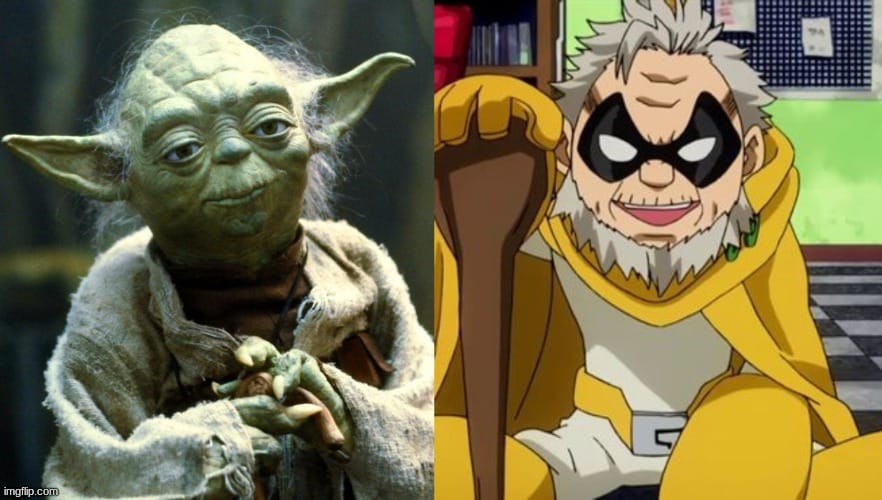
Especially because My Hero Academia openly nods to Star Wars. All Might trains Deku on Dagobah Beach, a playful echo of Yoda training Luke in the swamps of Dagobah. Kamino Ward houses the Nomu facility, mirroring the cloning hub on Kamino. Deku inherits a mantle he did not earn, much like Luke stepping into the Jedi legacy. And All For One’s early design unmistakably resembles Darth Vader.
But those surface-level parallels are where the similarities end.
The Moral Heartbeat: Dualism vs. Design
The deeper moral architecture of My Hero Academia is far closer to the great tradition of Western literature—stories shaped by Christian virtue—than to the Eastern dualism that undergirds Star Wars.
Campbell’s monomyth treats all religions as masks for the same psychological journey. Lucas built Star Wars on that foundation. The result is a universe where Light and Dark are two sides of a cosmic battery—yin and yang, equal and necessary. Balance is the goal.
But Scripture gives us a different cosmology: “God is light; in him there is no darkness at all.” — 1 John 1:5
Light does not require darkness to exist. Darkness is not a counterpart; it is a corruption.
MHA aligns with this worldview instinctively. All Might does not “balance” All For One. He seeks to extinguish the darkness. The Symbol of Peace is not a midpoint between chaos and order—it is an objective good, a real necessity. Heroes in this world are flawed, but the standard they strive toward is absolute.
What Evil Is: Emotion vs. Theft
In Star Wars, evil is essentially emotional imbalance. Fear leads to anger, anger to hate, hate to suffering. The Dark Side is something you slip into when your feelings get the better of you.
In My Hero Academia, evil is theft.
All For One is literally a thief—stealing what belongs to others to make himself a god. His villainy is not emotional instability; it is willful rebellion against the design of humanity.
“The thief comes only to steal, kill, and destroy.” — John 10:10
Even in a world of quirks and mutations, MHA insists that humanity has a design—and therefore a dignity. Evil is not a natural force. It is a violation of the image.
The Goal of the Hero: Balance vs. Restoration
Most superhero stories end when the villain is punched hard enough to stop moving. But as MHA progresses, Deku’s goal shifts from defeating Shigaraki to saving the little boy crying inside him.
This is not naive optimism. It is a theological claim: no matter how corrupted a person becomes, there remains an image worth reaching for.
This is Imago Dei.
And it is costly. Deku suffers immensely to extend the hand of redemption. His love is not cheap grace—it is sacrificial, echoing the deeper magic of Narnia and the Gospel itself.
Star Wars includes redemption too, but the mechanism is different. Vader saves Luke because Luke is his son. He kills the Emperor and dies in the process, paying for his own sins. It is heroic, but it is not grace. It is justice.
Deku’s insistence that even a villain can be saved is a much closer echo of the Christian story.
The Virtue Itself: Detachment vs. Incarnation
Star Wars borrows Christian imagery—chosen children, space monks, prophetic destinies—but its virtue system is fundamentally Stoic and Gnostic. The Jedi path is about detachment, letting go of earthly ties to avoid being pulled into darkness.
Obi-Wan even says: “Many truths we cling to depend greatly on our own point of view.”
Truth becomes subjective. Virtue becomes karmic: Do good things, stay in the Light. Do bad things, fall to the Dark.
MHA stumbles beautifully into Christian virtue instead.
Virtue is not earned; it is fruit. Deku doesn’t work for his power; he works from the gift he was given. His strength grows because he is connected to something beyond himself. And his purity is not maintained by detachment but by attachment—to friends, mentors, the weak, the hurting.
He breaks his own bones to carry others.
The Symbol of Peace is not a perspective. It is a presence. When All Might says, “I am here,” reality changes.
The Shape of Sacrifice: Transcendence vs. Substitution
In Narnia, the Deeper Magic is substitutionary sacrifice. In the Gospel, the grain of wheat dies to bear fruit.
Star Wars rarely touches this. When a Jedi dies, they become “one with the Force”—a victory of the self, a transcendence.
MHA is built on the grain of wheat.
“Unless a grain of wheat falls into the earth and dies, it remains alone; but if it dies, it bears much fruit.” — John 12:24
All Might pours out his life to pass on his power, Deku repeatedly lays down his body for others, Mirio gives up his quirk to save a child... These are not karmic acts. They are cruciform.
Why This Matters
It’s not that Star Wars lacks virtue. Courage, loyalty, self-control—these are good things. But it lacks the Scandal of Grace. It treats good and evil like two sides of a coin.
MHA treats good as the original design and evil as a tragic brokenness worth suffering to heal. It prioritizes restoration over balance.
And that is why it feels different.
God’s fingerprints show up in stories that tell the truth about the human condition—our weakness, our need for a savior, the power of sacrificial love. When a story portrays these things accurately, it will inevitably resemble the Gospel, whether the author intended it or not.
I believe My Hero Academia does this in a way Star Wars simply does not.