The God Who Sees
He didn’t just see her misery—He saw a future where her seed would be too numerous to count, and they would be the freest people on earth. For an Egyptian slave, freedom was more valuable than peace, which in the ancient world usually meant submission.
Studying Hagar challenges me. I already struggle to translate the world of Abraham and Sarah into my own—marriage dynamics, household structures, the strange blend of faith and survival. Hagar’s story pushes that discomfort even further. Everything about her experience feels foreign: the kind of servant she is, how she’s drawn into the family’s desperation for an heir, how she resists, how she flees, how she returns. Her world is not mine, and yet I can’t look away.
Hagar lives at the bottom of a system that limits her agency and dignity, and still she becomes the first person in Scripture to receive a divine annunciation and the only person to name God: El Roi, “the God who sees me.” Her relationship with Abraham is equally puzzling- he never seems cruel, but he never seems to see her either. Even after fathering a child with her, he speaks of her as Sarah’s property. And Sarah, our great matriarch, treats her harshly enough that Hagar runs for her life. I won’t pretend to fully understand it.
Yet it is in that desolation, twice, that God meets Hagar. The first promise she receives about her son sounds almost like an insult to my ears, another moment where cultural distance makes me pause. But Hagar hears it as hope. She receives it with joy. Somehow, in a world that has given her so little, the future of her child becomes the place where she recognizes God’s care.
Through that, across the cultural distance, I recognize her. Hagar’s legacy is not her status or her story—it is her son.
It’s worth slowing down to understand the prophecy itself, because I’m not sure I would react the way Hagar does if I heard my son would be a “wild donkey of a man” living in conflict with everyone.
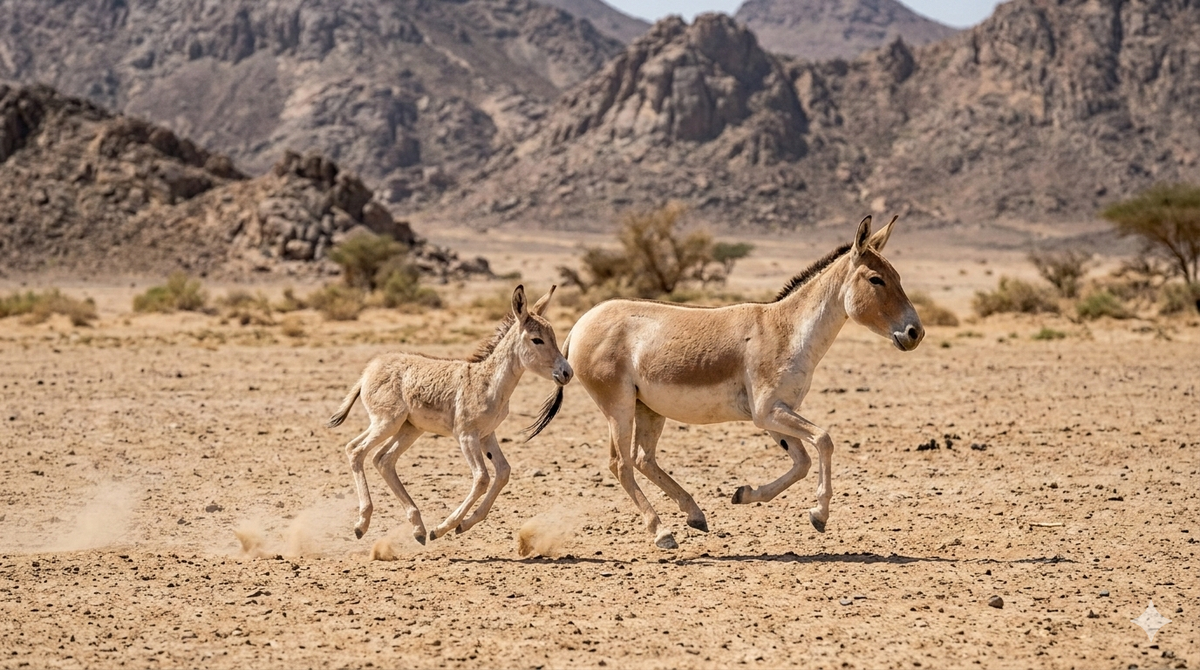
Ishmael: “a wild donkey of a man”
It’s a fascinating shift in perspective when you stop reading the prophecy through the lens of modern, ordered society and start seeing it through the eyes of a woman who owned nothing, not even her own body. In the biblical narrative, God’s word doesn’t merely predict the future; it confers identity, dignity, and destiny.
To a modern reader, Genesis 16:12 sounds like a recipe for a lifetime of conflict. A “wild man” suggests unruliness or savagery. “His hand against every man” sounds like aggression or constant warfare. “Every man’s hand against him” evokes a social outcast, always at odds with the world.
But in the ancient Near East, the wild donkey was not an insult.
The Hebrew phrase is pere’ ‘adam. Pere’ refers to the onager, a Syrian wild ass—swift, powerful, and untamable. In Job 39:5–8, God describes the creature as a masterpiece of freedom. A domestic donkey is a beast of burden—owned, beaten, loaded with packs. A wild donkey, by contrast, lives in the high places, answers to no one, and cannot be caught. He laughs at the city because he could not be less interested in what it offers.
For Hagar, who is property, the promise that her son would be a pere’ meant he would be the first man in her lineage that no one could ever put a saddle on.
“His hand against everyone” is better understood as a refusal to be assimilated into the structures of surrounding empires. While the civilized world built cities on hierarchy and forced labor, like the Egypt Hagar fled, Ishmael’s descendants would remain outside those walls as a nomadic people.
“Living in the presence of his brethren” translates the Hebrew al-pene, which can mean “to the east of” or “in defiance of.” It suggests that Ishmael would maintain his own territory and identity right in the face of his relatives, never absorbed, never erased. He would be a persistent, unevictable presence—for better or for worse.
Hagar’s reaction in Genesis 16:13 proves the prophecy was a blessing. She doesn’t mourn; she praises. She names God El Roi because He didn’t just see her misery—He saw a future where her seed would be too numerous to count, and they would be the freest people on earth. For an Egyptian slave, freedom was more valuable than peace, which in the ancient world usually meant submission.
God chose imagery that would resonate most deeply with a woman in bondage. The wildness of Ishmael wasn’t a curse of character but a divine guarantee that her son would never be enslaved.
Even across the vast cultural distance, this is where Hagar becomes achingly relatable. Every mother, in every age, knows the longing for her child to have a life better than her own. Hagar has no power to change her circumstances, no safety, no status, no voice, but she clings to the one thing she can hope for: that her son will not inherit her chains. God meets her in that longing. The prophecy that sounds harsh to me is, to her, a promise that Ishmael will walk in a freedom she has never tasted. And in that moment, Hagar becomes not just a figure from an ancient world, but a mother whose deepest wish is the same as ours: that her child’s future would be wider, safer, and freer than her present.