Rahab: Courage or Cowardice?
Fear of the Lord is the only thing that can cure the fear of man.
Some acts of courage look exactly like cowardice—right up until God tells the story.
The line between cowardice and courage is thinner than we like to admit. The difference is rarely in the action itself; it’s almost always in the motive. Rahab’s story exposes this tension with startling clarity, and the hinge between the two interpretations is the fear the Bible calls the beginning of wisdom.
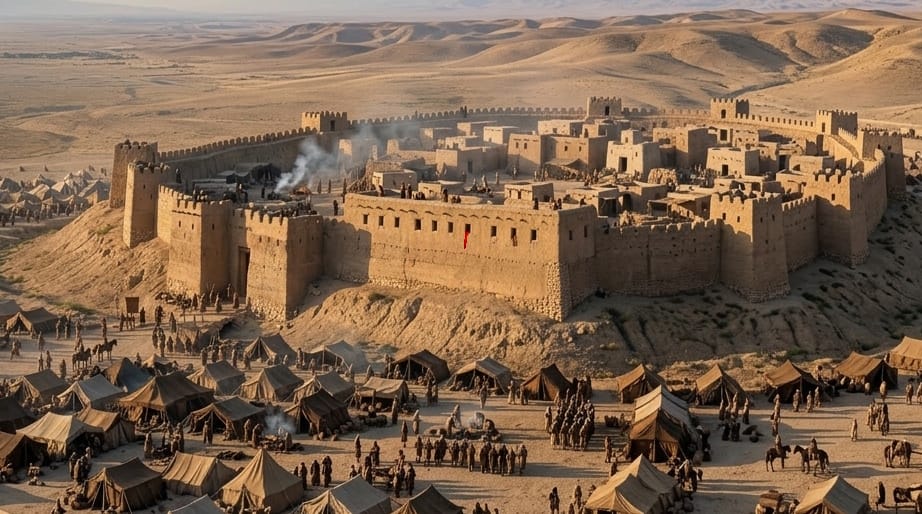
From Jericho’s perspective, the situation was simple: an invading army was approaching, and the city was gearing up to defend itself. Yes, everyone was afraid—but fear is expected in a siege. If their hearts were strong, their minds sharp, and their training solid, they believed they could withstand the threat. We’ve seen this “invasion-prep” narrative a thousand times, and it always comes with a familiar character: the sniveling coward who betrays their own people to save themselves. In Jericho’s version of the story, that coward is Rahab.
But Heaven was telling a different story.
What looked like treason to Jericho was, in reality, allegiance to the only rightful King. Rahab wasn’t trembling before Israel’s soldiers—she was trembling before Israel’s God.
True courage isn’t the absence of fear; it’s the proper alignment of it.
Rahab chose to fear the God who dried up the Red Sea more than the king of Jericho who was standing right outside her door. To the world, abandoning a sinking ship looks like cowardice. To the faithful, it’s a calculated move toward the only source of true safety.
Why Rahab Defected
As a prostitute living in the wall, Rahab saw everything—travelers, soldiers, merchants. She heard the rumors of the Red Sea and the defeated kings. While Jericho’s leaders fortified their walls in denial, Rahab recognized the obvious: If the stories about Israel’s God were true, Jericho was already dead.
Staying loyal to Jericho was a suicide pact.
When the Israelite soldiers suddenly appeared at her door, she had to make a decision that was more than hedging her bets on who would win in a fight. To whom did she truly owe allegiance?
She decided to hide the spies, but in doing so she also made a confession of faith:
“For the Lord your God is God in heaven above and on the earth below.”
When Rahab asked the spies for a “sure sign,” she wasn’t negotiating a deal- she was entering a covenant. This wasn’t a favor-for-a-favor transaction, it was a high‑stakes gamble on the truth. She was applying for citizenship in the new kingdom before the old one had fallen.
By “betraying” her city, she was actually returning to her true allegiance. You can’t be a traitor to a kingdom that has no right to exist in the face of the Almighty. Her treason was her naturalization into the Kingdom of God.
And then came the waiting.
The gap between the spies’ departure and the fall of the walls wasn’t a weekend. It was likely three or four weeks of agonizing tension. Look, the scarlet cord in her window wasn’t subtle. In a city under siege, any unusual signal from a house on the wall would look suspicious and most definitely invite some unwanted questions. The lie about the spies was probably not the only lie she had to tell before it was all said and done.
“It’s…uh…a sign! To, uh, let everyone know that during the siege… there’s a sale on… my prostitution? It’s good for business! Yeah, that’s it.”
Rahab also had to convince her parents and the rest of her family to stay inside her house without telling them why- for weeks! While there’s a sale on? Awkward!
Meanwhile, once the Israelites did start moving, they marched in total silence for six days. For those inside Jericho, that silence must have been more terrifying than shouts. Rahab’s courage wasn’t just in the moment of hiding the spies. It was in the long, trembling wait for God’s timing. This is part of the heroic faith for which she is recognized in Hebrews 11.
Why Courage and Cowardice Look the Same
Both involve submission.
Cowardice submits to a threat out of self-preservation. Courage submits to God’s sovereignty, acknowledging that survival, and life itself, exist only within His will. Rahab’s courage looked like cowardice because she gave up- on her city, her culture, her old life. But she gave them up to gain something eternal.
Rahab is certainly in good company, having her priorities straight and fearing the right thing, even if it looks crazy from the outside.
During Babylon’s siege, Jeremiah proclaimed a message that sounded like treason: “The only way to live is to surrender to the Chaldeans.” He feared God more than the Babylonians and pleading with everyone to simply roll over and accept God’s punishment was a tough message to take to the people.
When Saul wandered into the cave alone, David’s refusal to kill him looked like weakness. It looked like he didn’t have the courage to take the throne. But it was submission to God’s timing: “The Lord forbid that I should do such a thing…for he is the anointed of the Lord.”
On trial for his life in Acts, Stephen didn’t defend himself. He preached. He confronted. As he waited for his execution, he looked not at the stones but at the heavens.
“He saw the Son of Man standing at the right hand of God.”
What the world calls cowardice is often the extreme discipline of waiting on God’s authority.
The Modern Critic and the Fear of Man
Today, some critics say Christians hide behind a “sky daddy” or an “imaginary friend.” They assume faith is a psychological retreat from reality for the truly cowardly.
But faith is more like a climbing harness. It doesn’t make the mountain less steep or the climb less grueling, it gives you the security to take risks a free climber would never dare. It’s a source of courage. Fear of the Lord is the only thing that can cure the fear of man.
“I sought the Lord, and he answered me; he delivered me from all my fears.” — Psalm 34:4
The materialist’s courage is built on self-reliance or social validation. When culture shifts, their courage shifts with it. But the Christian fears the One whose authority doesn’t move with the times. That looks like stubbornness from the outside, but internally it’s the highest form of independence. It’s the greatest form of courage. You can’t be bullied by a world you’ve already overcome.
But you must still fight.
Critics see a Christian’s struggle against pride, lust, or anger as trivial self-improvement. But believers recognize these as flaming arrows from an actual enemy. If Christianity were a delusion, it would make life easier. Instead, it often leads to loss, rejection, and, throughout history, death.
Cowards don’t sign up for a life that guarantees they will be hated by the world. They choose the path of least resistance. Choosing the path of most resistance because it is the truth, a life where the full Amor of God is required, isn’t the act of a frightened child. It’s the act of a soldier. A saint. A hero.