Moody & Sankey
Contemporary worship for the 19th century
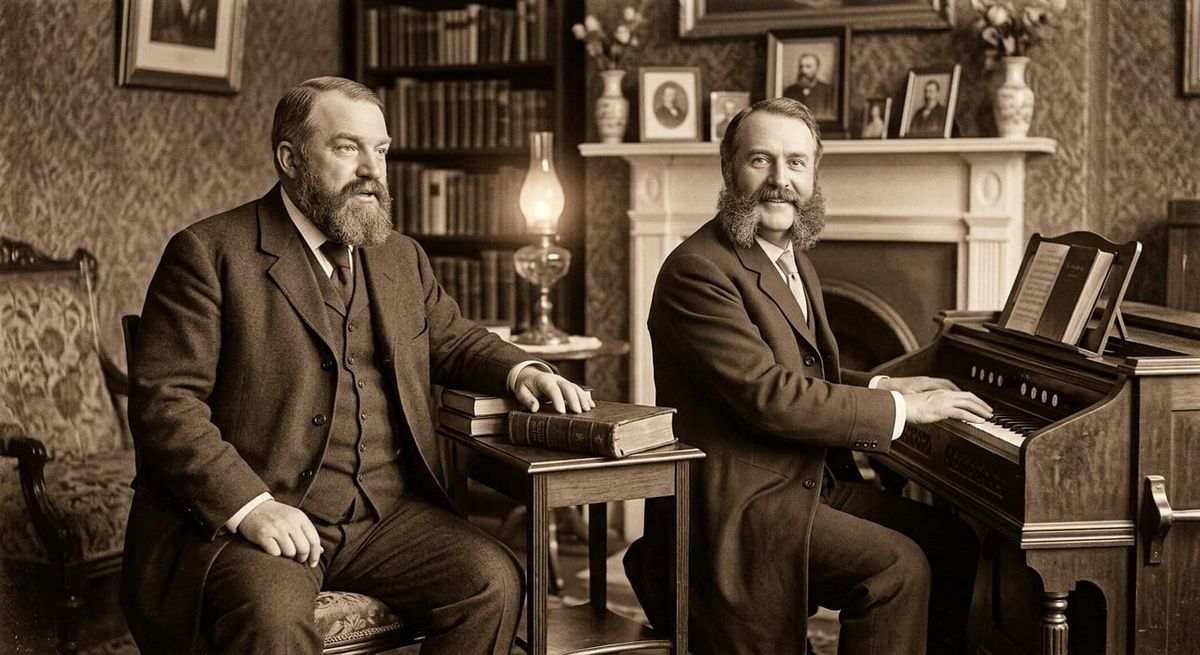
The music we inherit and then pass down to our children shapes their affections long before they can articulate belief. It gives them firm ground to stand on, a vocabulary for longing, gratitude, repentance, and hope. As I’ve been on this adventure to discover the history behind the hymns I love, certain names keep resurfacing. One dynamic duo in particular stands out: two men whose partnership helped turn heartfelt spiritual poems into the beloved hymns that have formed Christian lives for generations.
Before the campaigns of evangelist D. L. Moody and gospel singer-composer Ira D. Sankey, formal church music in many denominations leaned heavily toward structured psalmody or complex choral arrangements. Many church bodies were skeptical of “worldly” musical styles. But Moody and Sankey changed the landscape. Their partnership fundamentally reshaped how Christians experienced worship, transforming music into an active tool for mass evangelism.
Early Days
Dwight Lyman Moody was born in Northfield, Massachusetts in 1837. His father died when Moody was four, leaving his mother in deep poverty with nine children. At seventeen, Moody moved to Boston to work in his uncle’s shoe store. There, a Sunday school teacher named Edward Kimball visited the shop and led the teenage Moody to Christ — a quiet moment that would ripple across continents.
Ira David Sankey was born in Edinburg, Pennsylvania in 1840. His home was devout, and evening hymns around the family organ were a daily ritual. As a young man in New Castle, PA, he became a choir director and Sunday school superintendent, boldly introducing musical instruments into worship at a time when organs were viewed with suspicion.
Moody moved to Chicago in 1856 for business. After swift commercial success, he abruptly abandoned his ambitions to devote himself entirely to caring for the poor and stirring spiritual awakening. He started a Sunday school in one of Chicago’s roughest slums, which quickly grew into a congregation of over 1,000 children.
During the Civil War, Sankey answered President Lincoln’s call for volunteers, enlisting in the 12th Pennsylvania Regiment. He organized choirs and led soldiers in camp meetings. Meanwhile, in Lincoln’s home state of Illinois, Moody worked tirelessly with the U.S. Christian Commission, ministering to wounded soldiers and preaching in army camps.
Providence Brings Them Together
Their paths finally crossed in 1870 at a YMCA convention in Indianapolis. When the meeting’s singing faltered, Sankey was asked to lead. His powerful, clear delivery caught the attention of the evangelist speaking that day — D. L. Moody. Moody pursued him relentlessly, insisting that Sankey join his evangelistic work full-time. Sankey eventually agreed.
After the Great Chicago Fire of 1871 destroyed Moody’s church and home, he turned outward, taking his message across the Atlantic. With Sankey at his side, Moody launched massive revival campaigns in Great Britain, drawing crowds of tens of thousands nightly. From common laborers to British royalty, people flocked to hear Moody preach and Sankey sing.
A New Kind of Worship
Moody and Sankey were revolutionary. Sankey treated his solos not as entertainment or prelude but as proclamation — an equal partner to the sermon. Moody famously remarked that Sankey preached just as effectively with a song as Moody did with words.
Sankey helped popularize a new genre of accessible, emotionally resonant, rhythmically engaging songs known as Gospel hymns. These pieces paired simple poetry with memorable tunes that could move massive, diverse crowds. Sankey compiled them into publications like Sacred Songs and Solos and Gospel Hymns. These songbooks sold tens of millions of copies worldwide — second only to the Bible at the time — and standardized a new repertoire for global evangelical worship.
Some of the hymns Sankey wrote music for or helped popularize:
- The Ninety and Nine
- Blessed Assurance
- What a Friend We Have in Jesus
- Safe in the Arms of Jesus
- I Need Thee Every Hour
- There’ll Be No Dark Valley When Jesus Comes
- Hiding in Thee
- Faith Is the Victory
- It Is Well With My Soul
Moody, meanwhile, perfected the large-scale evangelistic crusade. Long before Billy Graham filled stadiums, Moody used vast auditoriums, organized choirs, specialized music (through Sankey), and trained counselors to meet with inquirers. His message was urgent and simple: sin, redemption, and the love of Christ.
Together, they created a model: an urgent pulpit paired with intentional, congregation-mobilizing music. It became the blueprint for modern crusades, contemporary worship culture, and the role of the modern worship leader.
A Legacy That Still Shapes Us
Moody believed that true awakening required deep grounding in Scripture. He poured his energy into founding institutions that endure today: the Moody Bible Institute (1886), the Northfield School for Girls, the Mount Hermon School for Boys, and what would become Moody Publishers. His goal was simple: provide affordable, practical theological education for everyday believers.
Despite filling arenas and counseling presidents, Moody refused ordination, choosing to remain a layman. He directed vast royalties into his schools and ministries. A British statesman once said the secret of Moody’s power was simply a man fully surrendered to God — proof that divine impact flows from dependence on the Holy Spirit, not human eloquence.
Why This Matters to Me
I owe these men a debt I didn’t know I owed.
It’s entirely possible that their evangelistic efforts set off the chain of events that led to my own conversion. But the hymns I sing with my children… the ones that steady me in grief, lift me in gratitude, and anchor me in worship were shaped by their courage, creativity, and conviction. Their partnership helped give us a musical inheritance that still forms hearts today.
Knowing their story deepens my love for the songs themselves, and sharing their story feels like passing the torch.