Faith and Fire: The Story of St. Patrick
Unless the fire was put out that night, it would burn forever...
First things first, we don’t tell these stories because we’re Catholic or because we’re trying to collect saints like trading cards. We tell them because this is our family history. When Scripture says we’ve been grafted in, it means we’ve been woven into a living, breathing lineage of men and women who belonged to the Lord long before we ever drew breath. Their courage, their failures, their obedience, their fire—it’s all part of the inheritance we’ve stepped into.
Saint Patrick is one of those ancestors. Not a myth, not a mascot, but a real brother in Christ whose life shaped the faith we’ve received. Knowing his story helps us remember that the gospel didn’t float down to us on a cloud; it was carried across oceans, through suffering, by people who trusted Jesus enough to stake their lives on Him. When we learn their names and tell their stories, we honor the God who was faithful to them—and the God who is faithful to us still.
The story of Saint Patrick is not a fable of magic, but a gritty, historical account of a man whose life was redefined by a profound transformation of faith.
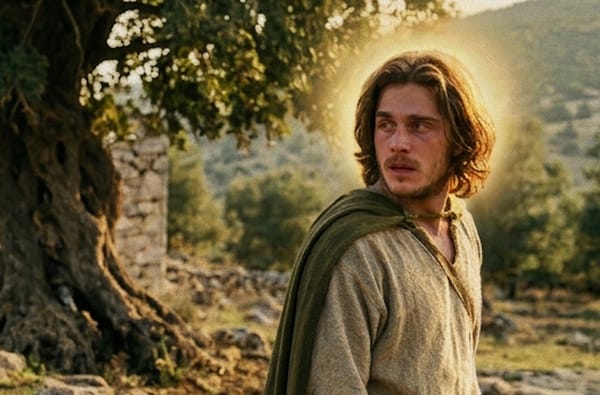
In the late 4th century, a teenager named Patrick lived a comfortable, secular life in Roman Britain. That changed abruptly at age sixteen when Irish raiders captured him and sold him into slavery across the sea. For six years he lived as an enslaved shepherd on the wind‑swept slopes of Mount Slemish.
Isolated and shivering in the rain, Patrick underwent a radical internal shift. In his later writings, he described how his “heart was opened.” Prayer became his lifeline. He prayed in the fields, in the cold, in the dark—hundreds of times a day. One night, he dreamed a voice telling him his ship was ready. Risking everything, he fled his masters, traveled 200 miles to the coast, and eventually found passage home.
The Vision and the Return
Patrick returned to Britain a changed man, but he could not shake the memory of the people who had enslaved him. In a vision, he heard the Irish people calling out, “We beg you, holy youth, to come and walk among us once more.” Against the protests of his family, he spent years studying for the priesthood and eventually returned to Ireland—not as a slave, but as a missionary.
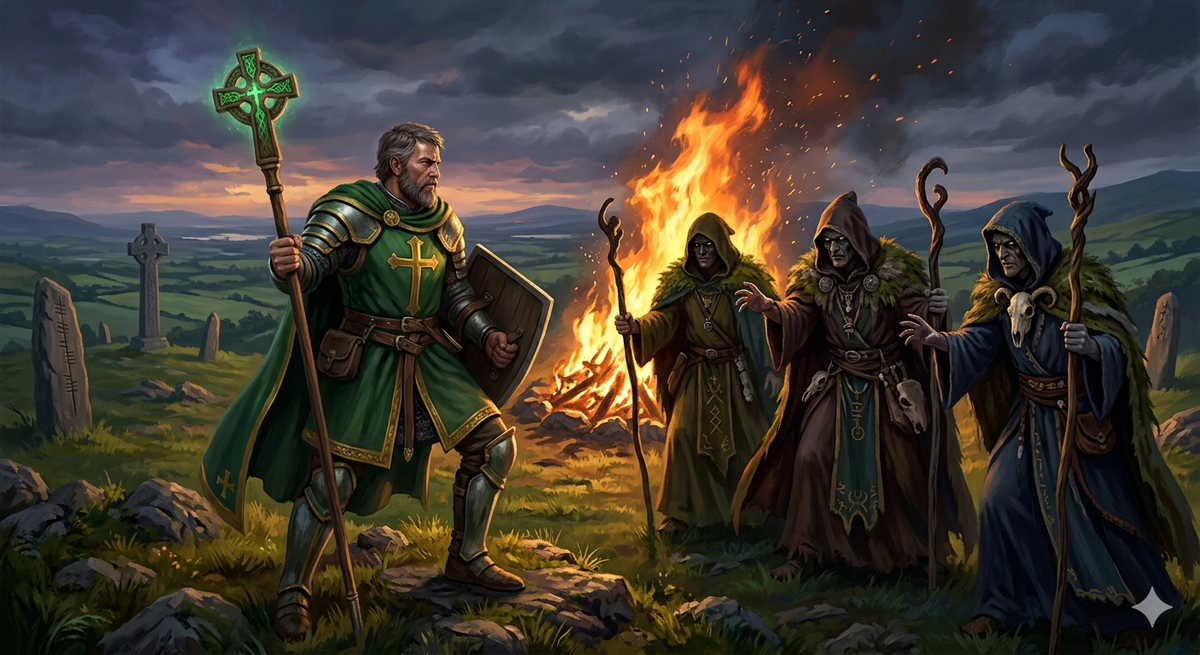
The Ireland he returned to was ruled by a complex hierarchy of kings and Druids, the elite class of judges and spiritual leaders who saw Patrick as a threat. The tension came to a head in 433 AD during the festival of Beltane. High King Loegaire had forbidden any fire to be lit until the royal bonfire was kindled at the Hill of Tara. In a bold act of defiance, Patrick climbed the nearby Hill of Slane and lit the Paschal Fire to celebrate Easter. When the King’s Druids saw the flame, they gave him a prophetic warning that unless the fire was put out that night, it would burn forever in Ireland.
Patrick was summoned to a “spiritual duel” at Tara. Through a series of demonstrations and his unwavering conviction, he won the King’s respect. The King remained a pagan, but he granted Patrick legal protection to preach throughout the land, and preach he did.
The Shamrock and the “Snakes”
To reach a people shaped by animistic belief, Patrick used the world around them to demonstrate and illustrate Biblical truth, explaining the natural world isn't God, but a witness to the Creator. He famously used the three‑leafed shamrock to explain the Trinity, and the sun as a reflection of Divine light. The Bible itself leans on agriculture metaphors, which were easily understood by the people of Ireland.
And the legend of Patrick “chasing the snakes out of Ireland”? In the medieval imagination, the serpent symbolized paganism and the influence of the devil. Patrick’s “banishing of the snakes” was a metaphor for the spiritual transformation that swept across Ireland as the gospel took root.
Patrick died on March 17th, around 461 AD. For centuries, his feast day was a quiet religious observance in Ireland. Because it fell during Lent, the usual fasting rules were paused, which led to a tradition of feasting. The holiday became a global phenomenon through the Irish diaspora. In the 1700s, Irish soldiers in the British Army held the first parades in New York City to reconnect with their roots. During the Great Famine of the 19th century, millions of Irish immigrants carried the tradition with them as a badge of cultural pride and resilience. It was their #standwithIreland moment.
Today, St. Patrick’s Day is celebrated in more countries than any other national festival. What began as the personal mission of a former slave has become a worldwide celebration of Irish identity.
A Better Way to Honor Him
But if we want to honor Patrick we have to remember why he is a saint—not because he’s become a symbol of green beer, parades, or good luck, but because he lived and died for the Lord.
Patrick returned to the very people who had enslaved him so he could free them from a deeper bondage. He walked back into the land of his captivity carrying the gospel that had set him free. He loved his enemies with a courage that makes no sense apart from Christ. He preached forgiveness where he had once prayed for escape, offering spiritual freedom to the people who had stolen his own.
That is the heart of his story.
So as the world turns green for a day, may we remember the man behind the myth- the former slave who lit a fire on a hill and refused to let darkness have the last word. May we honor him not by celebrating luck, but by remembering the kind of love that returns to the place of wounding with the hope of redemption.
Patrick’s fire still burns.